

Redesigning Housing Through Education
Overview The Living Curriculum Village (LCV) is a behavioural policy model that reimagines international student housing as an integrated education and infrastructure solution. Instead of capping enrolments or imposing deterrents, this model links demand with new supply through co-designed student accommodation embedded within vocational and higher education curricula.
The Problem: Misaligned Systems, Unshared Effort Australia’s international education sector contributes over $51 billion annually (Cassidy, 2024), but metro housing systems haven’t adapted to support that growth. Policy responses often focus on suppressing demand — through visa friction or enrolment caps — without creating capacity. This leads to trust breakdowns, moral hazard between states and federal agencies, and public resentment toward students who make up only 4% of renters (Student Accommodation Council, 2024).
From a behavioural perspective, current policies rely on deterrence and sludge — increasing costs, friction, and unpredictability for students without solving structural failures in housing supply (Thaler, 2018).
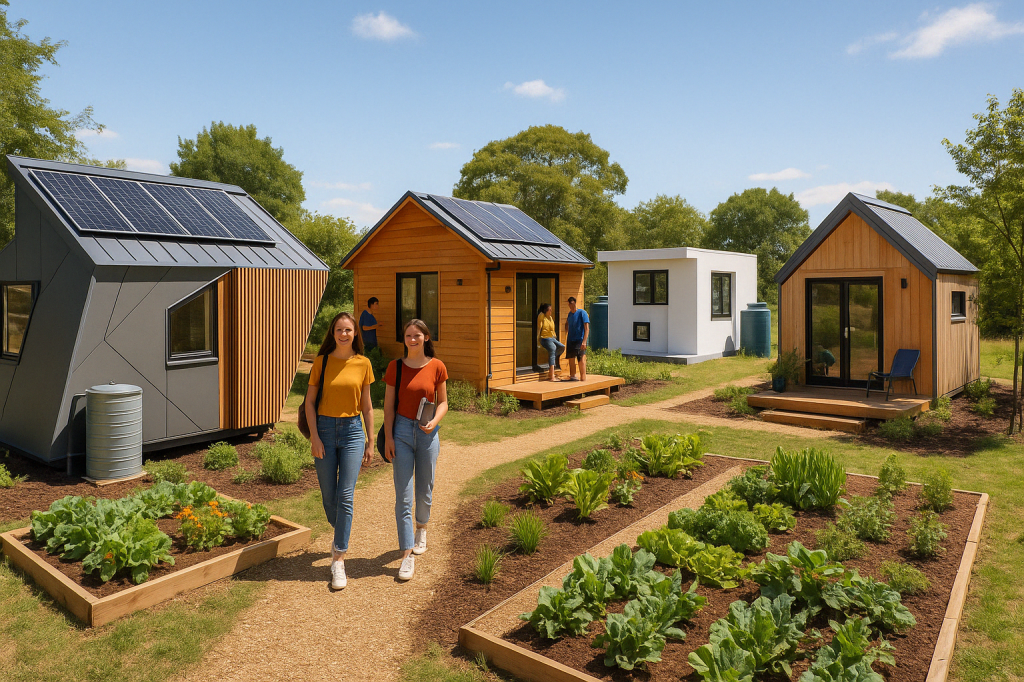
The Living Curriculum Village Solution The LCV model addresses coordination failure by embedding housing into education itself:
- Purpose-built tiny home villages co-designed by students in building, horticulture, health, and design programs
- Located in outer-metro or regional zones with strong transit links (ABC News, 2023)
- Supported through partnerships between TAFEs, universities, councils, and cooperatives
- Integrated services: shuttle transport, e-bikes, health services, co-working, and micro-retail
- Students help build and maintain the villages, earning credits and housing simultaneously
Behavioural Design Principles at Work
- Friction Reduction: Housing and transport are bundled, removing decision fatigue and bureaucratic delays
- Identity Cues: Students live in spaces they’ve helped design, reinforcing ownership, belonging, and prosocial norms
- Empowerment-by-Design: Unlike visa sludge or caps, this model builds student agency into the system
- Public Goods Framing: Housing is treated as a shared system asset, not a zero-sum rental competition (Ostrom, 1990)
Coordination Logic
- Shifts housing responsibility from ad hoc market forces to structured co-investment
- Reduces pressure on councils by using university land and opt-in tenancy models
- Aligns education, housing, and regional development portfolios — creating shared accountability
- Improves retention, wellbeing, and local economic activation in non-metro areas
Why It Belongs on Thinkynd This case represents a high-impact application of behavioural systems design. It moves beyond crisis framing and scarcity logic, instead showing how reframing a problem — from “too many students” to “too little designed capacity” — can unlock cooperation, trust, and long-term value.
“The Living Curriculum Village is not just housing policy. It’s education, infrastructure, and public value — built together.”
References
- ABC News. (2023). Tiny homes caught in red tape, despite calls for solutions to Australia’s housing crisis.https://www.abc.net.au/news/2023-04-27/tiny-homes-red-tape-housing-crisis-regulation/102207374
- Cassidy, J. (2024). Fee increase for international students part of 1 July migration reforms. Ministers’ Media Centre, Australian Government.
- Ostrom, E. (1990). Governing the Commons: The Evolution of Institutions for Collective Action. Cambridge University Press.
- Student Accommodation Council. (2024). International students and the housing market: facts vs myths. Property Council of Australia.
- Thaler, R.H. (2018). Sludge and what to do about it. Behavioural Public Policy, 2(2), pp.177–186.


 ThinKynd